
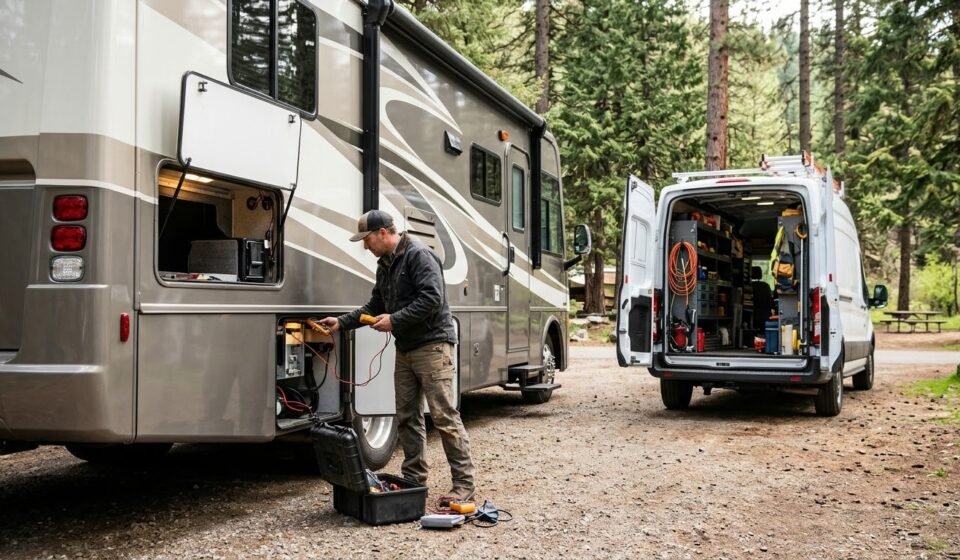

RV problems can happen at inconvenient times, whether you are traveling across the country, staying at a campground, or preparing your vehicle for another trip. Taking a large recreational vehicle to a traditional repair shop is not always easy. This is where RV mobile repair becomes a practical option.
Mobile RV repair technicians travel to your location to diagnose and fix common problems. Depending on their equipment, experience, and service area, they may handle electrical issues, plumbing problems, air conditioning failures, appliance repairs, roof leaks, and general maintenance.
However, mobile service is not suitable for every repair. Understanding what technicians can do, how much their services may cost, and how to choose a dependable provider can help you make a better decision.
What Is RV Mobile Repair?
RV mobile repair is a service in which a qualified technician travels to your location instead of requiring you to bring your recreational vehicle to a repair facility.
You can usually request service at a campground, RV park, storage facility, private property, or another accessible location. Some providers also offer roadside assistance for certain breakdowns.
Mobile RV repair is especially useful when your vehicle is difficult to move or when a problem affects an essential system. For example, an electrical failure, plumbing leak, or malfunctioning slide-out may make traveling to a repair shop inconvenient or unsafe.
The technician typically inspects the problem, explains the available repair options, provides an estimate, and completes the work if the necessary parts and equipment are available.
What Services Do Mobile RV Repair Technicians Offer?
The services available depend on the technician’s training, tools, experience, and service area. Many mobile RV repair businesses handle several common systems.
Electrical System Repairs
Electrical problems can affect lighting, outlets, batteries, converters, inverters, and other equipment. A mobile technician may inspect wiring connections, test electrical components, troubleshoot power failures, and identify faulty parts.
Electrical repairs should be handled carefully because incorrect work can create fire, shock, or equipment-damage risks.
Plumbing and Water System Repairs
RV plumbing systems include freshwater tanks, water pumps, faucets, toilets, pipes, and water heaters. Technicians may diagnose leaks, replace damaged fittings, repair pumps, and troubleshoot water-pressure problems.
Some providers also offer inspections to identify potential leaks before they cause extensive damage.
Air Conditioning and Heating Repairs
A malfunctioning air conditioner or heating system can make an RV uncomfortable, particularly during extreme weather.
Depending on their qualifications, mobile technicians may inspect thermostats, electrical connections, airflow, control boards, and other components. Refrigerant-related work may require additional qualifications and equipment.
Refrigerator and Appliance Repairs
RV refrigerators, cooktops, microwaves, water heaters, and other appliances can develop mechanical or electrical problems.
A technician may troubleshoot power supplies, control systems, ignition components, and other parts. Some repairs require manufacturer-specific parts or specialist service, so not every appliance issue can be resolved during the first visit.
Roof, Sealant, and Water Damage Inspections
Roof leaks can cause serious damage if moisture reaches walls, ceilings, insulation, or flooring.
Mobile RV technicians may inspect roof membranes, vents, seams, windows, and exterior seals. They can sometimes reseal small problem areas or recommend more extensive repairs when structural damage is present.
Slide-Outs, Awnings, and Leveling Systems
Slide-outs, awnings, and leveling equipment contain mechanical and electrical components that may require troubleshooting.
Some technicians specialize in components manufactured by companies such as Lippert. Their work may include inspecting motors, switches, wiring, hydraulic systems, and mechanical movement.
Routine Maintenance and Inspections
Mobile RV repair is not limited to emergency breakdowns. Many providers offer preventive maintenance, seasonal inspections, battery checks, roof inspections, appliance testing, and winterization or de-winterization services.
Regular maintenance can help identify developing problems before they interrupt a trip.
How Does Mobile RV Repair Work?
The process is generally straightforward, although individual companies may follow different procedures.
1. Contact a service provider
Explain the problem, describe your RV, and provide your current location. Include the vehicle’s make, model, year, and type if available.
2. Describe the symptoms
Tell the technician what happened, when the problem started, and whether you noticed warning lights, unusual sounds, leaks, odors, or other symptoms.
3. Confirm availability and service coverage
Ask whether the provider travels to your location and whether your particular repair is within their capabilities.
4. Request a cost estimate
Before confirming the appointment, ask about diagnostic charges, travel fees, hourly labor rates, parts, and possible emergency surcharges.
5. Arrange the appointment
Confirm the expected arrival window and make sure the RV is accessible. Some campgrounds or storage facilities may require permission before outside technicians can perform repairs.
6. Review the diagnosis and repair
The technician should explain the problem and discuss the recommended work before proceeding with additional charges.
7. Keep the service documentation
Request an itemized invoice describing the diagnosis, work performed, parts installed, and any applicable warranty.
How Much Does RV Mobile Repair Cost?
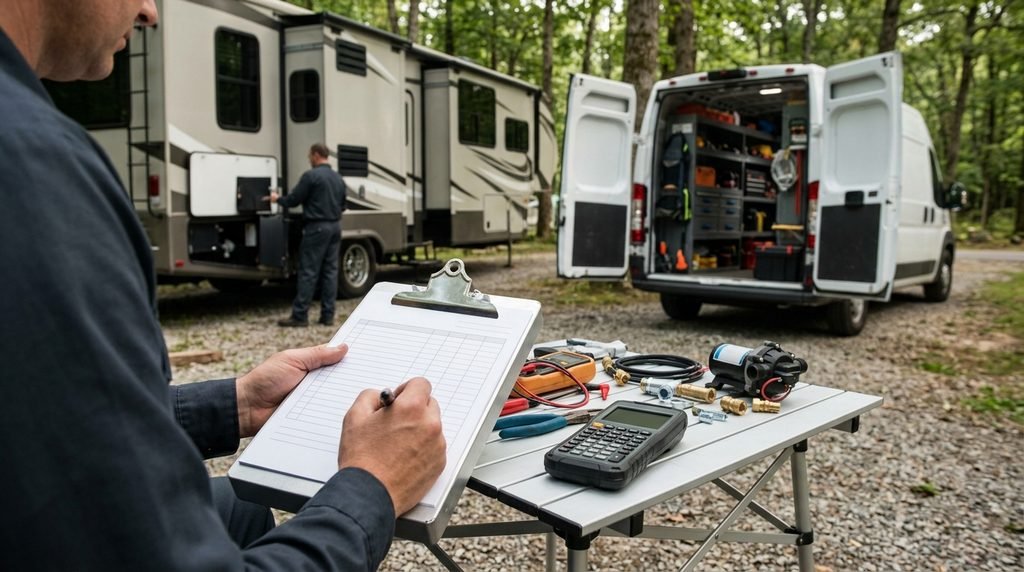
The cost of RV mobile repair depends on several factors, including the type of problem, technician experience, location, travel distance, parts, and urgency.
Unlike a traditional repair shop, a mobile provider may charge a separate service-call or travel fee because the technician must travel to your vehicle.
Common cost components include:
- Service-call fee: Covers the technician’s trip to your location.
- Diagnostic fee: Pays for inspecting and identifying the problem.
- Hourly labor: Covers the time required to complete the repair.
- Parts and materials: Includes replacement components, fittings, wiring, and other supplies.
- Emergency surcharge: May apply to urgent, after-hours, weekend, or holiday appointments.
- Additional travel charges: May apply when your location is outside the provider’s standard service area.
For context, some individual providers publish examples such as a $75 service-call fee and a $150 initial diagnostic hour. Other providers advertise a $75 trip fee within a defined service radius and labor rates around $150 per hour.
These are examples from individual businesses, not national average prices. Rates can vary considerably by location and repair type.
Before hiring anyone, request a written estimate that separates travel, diagnosis, labor, and parts. Also ask whether the diagnostic fee is credited toward the repair if you approve the work.
Mobile RV Repair vs. Traditional RV Repair Shops
Both mobile technicians and traditional repair facilities have advantages. The better choice depends on the nature of the problem and the equipment required.
When Mobile RV Repair Is Better
Mobile service may be the more convenient option when:
- Your RV cannot be driven safely.
- You are staying at a campground or RV park.
- The problem involves a repair that can be completed on-site.
- You want to avoid arranging transportation for a large vehicle.
- You need an inspection or routine maintenance at your location.
When a Traditional Repair Shop Is Better
A repair facility may be more appropriate when:
- The repair requires specialized lifting equipment.
- Extensive structural or bodywork is necessary.
- The vehicle needs major engine or transmission work.
- Specialized diagnostic equipment is unavailable to the mobile technician.
- The repair requires a controlled workshop environment.
Some problems begin with a mobile diagnosis but ultimately require transportation to a fully equipped repair facility.
| Factor | Mobile RV Repair | Traditional Repair Shop |
|---|---|---|
| Location | Technician travels to you | You bring the RV to the facility |
| Convenience | Often more convenient | May require transportation |
| Travel charges | May include a service-call fee | Usually no technician travel fee |
| Equipment | Depends on mobile setup | May have larger specialist equipment |
| Repair suitability | Many common on-site repairs | Better for extensive workshop repairs |
| Scheduling | Depends on technician availability | Depends on shop appointments and workload |
Benefits of Hiring a Mobile RV Repair Technician
Mobile RV repair offers several practical advantages for vehicle owners.
Convenient On-Site Service
You do not need to move your RV to a repair facility for every problem. This can be particularly helpful when the vehicle is parked at a campground or has a fault that makes driving difficult.
Less Travel and Transportation Planning
Driving a large motorhome or towing a travel trailer to a repair shop can be inconvenient. Mobile service removes the need to make that trip when the repair can be completed on-site.
Useful During Travel
A breakdown can interrupt a planned vacation or long-distance journey. A technician who serves your location may help identify the problem and determine whether it can be repaired without leaving the area.
Access to Preventive Maintenance
Some providers offer scheduled inspections and maintenance at your storage location or home. This makes it easier to address small issues before they become larger problems.
Direct Communication
Working with a technician at your vehicle can make it easier to describe symptoms, review findings, and understand the recommended repair.
However, convenience does not automatically mean lower cost or faster service. Always compare the total estimate and confirm the provider’s availability.
What Problems Can Mobile RV Technicians Not Always Fix?
Mobile RV repair is useful, but it has limitations. A technician may not have the equipment, replacement parts, or workspace needed for every repair.
Examples include:
- Major engine and transmission repairs.
- Extensive collision or structural damage.
- Large-scale roof replacement.
- Complex chassis or suspension repairs.
- Repairs requiring specialized workshop machinery.
- Jobs involving unavailable or manufacturer-restricted components.
A technician may also need to order parts before completing a repair. In some cases, an initial visit is only enough to diagnose the problem.
Ask about these limitations before scheduling an appointment. A reliable provider should explain whether the repair is likely to be completed at your location or whether a repair facility may be necessary.
How to Find a Reliable Mobile RV Repair Technician
Choosing the right technician matters because RV systems can be complicated and repairs may involve electrical, mechanical, plumbing, and appliance components.
Use the following steps to evaluate a provider.
Check Experience and Training
Ask how long the technician has worked with recreational vehicles and whether they have experience with your particular RV type and problem.
Training from organizations such as the National RV Training Academy (NRVTA) or RV Technical Institute (RVTI) can be useful indicators of professional development. However, credentials should be considered alongside practical experience and customer feedback.
Read Recent Customer Reviews
Look for reviews that discuss punctuality, communication, workmanship, pricing transparency, and whether the repair solved the problem.
Do not rely on a single positive or negative review. Consider the overall pattern and pay attention to how the business responds to complaints.
Confirm Insurance and Business Details
Ask whether the provider has appropriate business insurance and any required local licenses or qualifications. Requirements can vary by location and type of work.
Ask About Warranties
Find out whether labor and replacement parts are covered by a warranty. Request the terms in writing and ask what happens if the same problem returns.
Compare Estimates
Contact more than one provider when time allows. Compare the service-call fee, diagnostic charge, labor rate, estimated parts cost, and expected appointment window.
The cheapest quote is not necessarily the best choice. Experience, transparency, and repair quality also matter.
Confirm Service Area and Availability
A business may advertise mobile RV repair but only cover specific cities or nearby communities. Confirm that the technician serves your exact location before relying on an advertised service area.
Is Emergency Mobile RV Repair Available?
Some mobile RV repair companies offer emergency or urgent appointments. These services may be useful when an RV develops a serious problem during a trip or when a breakdown makes it difficult to continue traveling.
However, emergency availability is not guaranteed. It depends on the technician’s schedule, location, weather, parts availability, and the type of repair required.
When requesting urgent help, provide:
- Your exact location and a suitable contact number.
- Your RV’s make, model, and year.
- A clear description of the problem.
- Whether the RV can be driven or moved.
- Any visible leaks, electrical symptoms, or warning indicators.
Ask about emergency travel charges and the expected arrival window before confirming service.
If you smell gas, see smoke, notice an electrical fire, or suspect a dangerous fuel or propane leak, prioritize immediate safety. Move away from the hazard when appropriate and contact emergency services or the relevant utility provider rather than attempting a repair yourself.
How to Prepare for a Mobile RV Repair Appointment
A little preparation can help the technician diagnose the problem more efficiently.
Before the appointment:
- Clear the work area: Remove personal belongings and make the affected equipment accessible.
- Record the symptoms: Note when the issue began and whether it happens consistently or occasionally.
- Take photographs: Pictures of visible damage, leaks, warning messages, or faulty components may help explain the issue.
- Gather RV information: Keep the owner’s manual, appliance details, model numbers, and previous repair records available.
- Arrange site access: Check campground or storage-facility rules and confirm that the technician can enter.
- Secure pets and valuables: Make the working area safe and accessible.
- Discuss the estimate: Confirm diagnostic charges, travel fees, labor rates, and approval requirements before work begins.
Avoid dismantling electrical, propane, or mechanical systems before the appointment unless a qualified professional has specifically advised you to do so.
Is RV Mobile Repair Worth It?
RV mobile repair can be worth the cost when convenience, location, and the condition of your vehicle make traveling to a repair shop difficult.
It is particularly useful for many electrical, plumbing, appliance, roof-seal, slide-out, and maintenance problems that can be handled with mobile equipment.
However, the service may not be the best choice for extensive mechanical repairs or jobs that require specialized workshop facilities. Travel fees and emergency charges can also increase the total bill.
The best approach is to describe the problem accurately, compare qualified providers, confirm the full cost, and ask whether the repair can realistically be completed at your location. A transparent estimate and a technician with relevant experience will help you make a more confident decision.
Frequently Asked Questions
1. What Does a Mobile RV Repair Technician Do?
A mobile RV repair technician travels to your location to diagnose and repair common recreational vehicle problems. Services may include electrical troubleshooting, plumbing repairs, appliance maintenance, air conditioning inspections, roof sealing, slide-out repairs, and general maintenance.
2. How Much Does Mobile RV Repair Usually Cost?
The cost varies by location, repair type, travel distance, labor time, and replacement parts. Some providers charge a service-call fee in addition to diagnostic and hourly labor charges. Request an itemized estimate before approving the work.
3. Can a Mobile RV Mechanic Repair My RV at a Campground?
Many mobile RV technicians provide services at campgrounds and RV parks. However, availability depends on the provider’s service area and the campground’s rules. Contact the facility and technician before arranging the appointment.
4. Is Mobile RV Repair Better Than Taking an RV to a Shop?
Mobile repair is often more convenient for common on-site problems, especially when an RV cannot easily be moved. Traditional repair shops may be better for major mechanical work, extensive structural repairs, or jobs requiring specialized equipment.
5. How Do I Choose a Reliable Mobile RV Repair Service?
Check the technician’s relevant experience, training, recent customer reviews, insurance, service area, and warranty terms. Compare written estimates and ask whether the provider has handled your specific RV model and repair problem before.
Conclusion
RV mobile repair provides a convenient way to handle many recreational vehicle problems without traveling to a traditional workshop. By understanding available services, comparing costs, checking technician qualifications, and preparing for appointments, RV owners can make informed decisions. Choose a provider who communicates clearly, explains limitations, and offers a detailed estimate before beginning any repair work.
Related Post