

T-Mobile FWA rural deployment is part of the broader effort to bring high-speed internet to American communities where traditional broadband options may be limited. Fixed wireless access (FWA) uses cellular networks to deliver internet service to a fixed location, such as a home or small business, without requiring a dedicated wired connection to every property.
For rural households, this technology can offer an alternative to DSL, cable, fiber, and satellite internet. However, the availability of T-Mobile Home Internet depends on more than whether a mobile phone can receive a 5G signal. Network capacity, signal quality, infrastructure, and address-specific eligibility all influence whether a household can subscribe and what performance it may experience.
T-Mobile announced a target of 15 million 5G broadband customers by the end of 2030, alongside a separate target of 3–4 million T-Fiber customers. These company-wide goals indicate an intention to grow its broadband business, but they do not guarantee that every rural community will receive service.
Understanding how FWA deployment works helps explain where rural internet access may improve, why some locations remain ineligible, and what consumers should consider when choosing a provider.
How T-Mobile FWA Works in Rural Areas
Fixed wireless access delivers broadband through a wireless connection between a cellular network and equipment installed inside a customer’s home. Instead of receiving internet through a physical cable running directly to the property, the home gateway communicates with a nearby cellular site.
T-Mobile’s 5G Home Internet service uses this general approach to provide connectivity to eligible addresses.
Several components work together to deliver the connection:
- Cell towers and network sites: These provide wireless coverage across surrounding areas.
- Spectrum: The radio frequencies used to transmit data affect coverage, capacity, and performance.
- Network backhaul: This carries data between cell sites and the wider internet.
- Home gateway: This equipment receives the cellular signal and distributes internet access through Wi-Fi or compatible wired connections.
- Network capacity: The available resources must support mobile customers and fixed wireless subscribers without unacceptable performance degradation.
Rural deployment can be especially challenging because homes are often spread across large geographic areas. A single network site may serve a broad region, while terrain, vegetation, buildings, and distance can affect signal quality.
FWA can reduce the need to construct a separate wired connection to every home, but it still depends on adequate cellular infrastructure and available network resources.
T-Mobile’s Rural FWA Deployment Strategy
T-Mobile’s fixed wireless strategy builds on its existing cellular network. This approach can allow the company to offer home internet in areas where its infrastructure already supports suitable coverage and capacity.
Rather than treating every rural location as a completely new construction project, operators can expand service by upgrading existing sites, improving network efficiency, deploying additional equipment, and making more locations eligible when capacity permits.
T-Mobile’s broadband expansion targets
In February 2026, T-Mobile announced an updated target of 15 million 5G broadband customers by the end of 2030. It also projected 3–4 million T-Fiber customers by that date, bringing its total broadband target to 18–19 million customers.
The company identified several factors supporting its 5G broadband ambitions, including improved spectrum efficiency, better customer-premises equipment, expanded eligibility, and additional product offerings.
These targets provide useful context for understanding the company’s broadband plans. However, they cover the broader business rather than a specific rural deployment schedule.
They do not establish how many new rural towers will be built, which counties will receive upgrades, or when an individual address will become eligible.
Why existing infrastructure matters
Using existing cellular infrastructure can make FWA more practical than constructing a new wired network to every property. Nevertheless, the presence of a tower does not automatically mean it can support additional home internet customers.
A site may need more capacity, stronger backhaul, upgraded radio equipment, or improved coverage before a surrounding area can support more subscriptions.
In locations where existing infrastructure is insufficient, additional investment may be necessary. The cost and expected demand can influence how quickly an operator expands.
For rural households, the practical result is that deployment often happens unevenly. One community may gain access before a nearby area, even when both are within the same general mobile coverage region.
Why Some Rural Areas Still Lack T-Mobile Home Internet
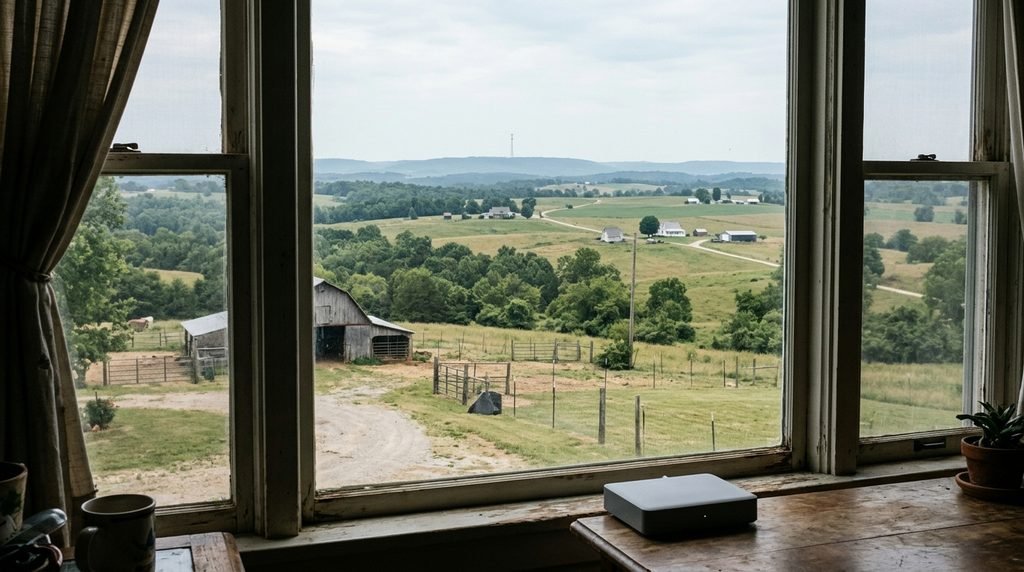
One of the most confusing aspects of fixed wireless internet is that a location can receive a mobile signal without qualifying for a home internet subscription.
T-Mobile determines Home Internet eligibility using the service address and factors that include local network capacity. Its official eligibility guidance also notes that availability can vary between nearby addresses.
Several factors help explain these differences.
1. Limited network capacity
A cellular site has finite resources for handling data traffic. The operator must account for mobile users, home internet customers, and other network demands.
If a site is already heavily utilized, adding more fixed wireless customers could affect the experience for existing users. Restricting new subscriptions in some areas can help manage that demand.
Eligibility may change when capacity improves or usage patterns change.
2. Signal strength and terrain
Rural homes may sit far from a cell site or behind hills, dense vegetation, or other obstructions. These conditions can weaken the signal reaching the home gateway.
Even when a phone receives service outdoors, the signal available inside a particular house may be less suitable for a consistent broadband connection.
3. Backhaul limitations
A cell tower needs a reliable connection to the wider network. If its backhaul is limited, adding wireless coverage alone may not deliver the required internet capacity.
Upgrading backhaul can therefore be an important part of improving service in rural locations.
4. Infrastructure investment costs
Building or upgrading a network in sparsely populated areas can be expensive relative to the number of potential customers. Construction, power, backhaul, site access, and equipment all affect deployment economics.
These costs do not make rural expansion impossible, but they can influence its pace and geographic priorities.
5. Address-specific restrictions
Service eligibility may differ between homes on the same road because network conditions and available capacity are not uniform. Some buildings or multi-unit properties may also face additional restrictions.
For these reasons, a general coverage map should not be treated as confirmation that a particular household can order T-Mobile Home Internet.
Rural Versus Urban FWA Deployment
The growth of fixed wireless internet has created an important question: how much of the technology’s expansion is reaching rural communities compared with urban and suburban markets?
Historical industry research and more recent reporting offer different perspectives, but their statistics must be interpreted carefully.
A 2022 report from the Benton Institute for Broadband & Society discussed estimates suggesting that rural customers represented approximately one-third of T-Mobile FWA subscribers at that time, despite rural locations representing a much smaller share of locations eligible for the service in the cited analysis.
In November 2025, separate industry reporting described a T-Mobile executive’s statement that roughly 70% of new FWA activations came from the country’s 100 largest cities. The report also discussed the urban and suburban share of quarterly sales.
These figures measure different things across different periods. The historical rural subscriber estimate describes the composition of an existing customer base, while the later figures concern new activations and sales.
Neither statistic alone establishes how much rural coverage has expanded or how many rural households can currently subscribe.
Why the distinction matters
Rural households may rely heavily on FWA because wired alternatives are limited. That can make fixed wireless particularly valuable in rural markets, even when a carrier also gains substantial numbers of customers in cities.
Urban and suburban demand can also support FWA growth without directly revealing what is happening in rural areas.
A fair assessment of deployment should therefore consider several measures together:
- The number of addresses eligible for service.
- The number of customers actually using the service.
- The geographic distribution of network infrastructure.
- Changes in capacity and service quality.
- Coverage and availability trends over time.
This broader view provides a more reliable understanding than interpreting a single percentage as proof of either successful rural expansion or insufficient rural investment.
How to Check T-Mobile Home Internet Availability in Rural Areas
The most reliable way to determine whether T-Mobile Home Internet is available is to check the exact service address through the company’s official eligibility checker.
Follow these steps:
- Visit T-Mobile’s official Home Internet website.
- Open the address eligibility checker.
- Enter the complete home address, including the correct unit or apartment number if applicable.
- Review the plans or options available for that address.
- If service is unavailable, check again later or ask T-Mobile whether a waiting list is offered for the location.
The official eligibility checker is more useful than relying on a nearby customer’s experience or a general mobile coverage map.
If your address qualifies, consider the expected performance before committing. Ask whether the available plan meets your needs and review its service terms, network-management policies, and equipment requirements.
If you already use T-Mobile mobile service, do not assume that your existing phone plan automatically makes your home eligible for FWA. Mobile coverage and fixed wireless eligibility are separate considerations.
How to evaluate performance after installation
If you obtain service, place the gateway where it can receive a strong cellular signal while still distributing Wi-Fi effectively throughout the home.
Test the connection at different times of day, particularly during busy evening periods. Compare download speed, upload speed, latency, and reliability rather than judging the service by one speed test.
A wired Ethernet connection can help determine whether a problem originates in the cellular connection or in the home’s Wi-Fi network.
T-Mobile FWA Compared With Other Rural Internet Options
T-Mobile FWA is one of several options rural households can consider. The best choice depends on availability, household usage, performance requirements, and total cost.
| Internet type | Potential advantages | Main limitations |
|---|---|---|
| T-Mobile FWA | Wireless delivery, relatively simple installation, no dedicated cable to the home | Address restrictions, variable speeds, network congestion |
| Fiber | High capacity, consistent performance, strong upload speeds | Limited availability in many rural locations |
| Cable | Often reliable and suitable for streaming and everyday use | Coverage gaps and potentially limited upload performance |
| DSL | May be available through existing telephone infrastructure | Speeds can be limited by line quality and distance |
| Satellite | Can reach homes far beyond many terrestrial broadband networks | Performance, latency, equipment costs, and service conditions vary by system |
Fiber is often attractive when it is available and affordable, especially for households that need consistent upload speeds or handle demanding workloads.
FWA may be a practical alternative when wired broadband is unavailable or requires expensive construction. Satellite can be important for remote properties outside suitable terrestrial coverage, although its costs and performance characteristics differ by provider.
Rural consumers should compare actual availability at their address instead of assuming one technology is universally superior.
What Could Shape Future Rural FWA Expansion?
Several developments could influence how T-Mobile and other providers expand fixed wireless service over the coming years.
Improved network efficiency
Better spectrum utilization and more efficient network equipment can increase the amount of traffic a network handles. Improvements may allow operators to serve additional customers without relying exclusively on new tower construction.
However, efficiency gains do not remove the need for adequate signal quality, backhaul, and local capacity.
New and upgraded network sites
Additional sites or upgrades to existing infrastructure can improve coverage and capacity in underserved locations. The impact depends on where the infrastructure is placed and which communities it serves.
A new site can benefit nearby households without necessarily making every address in the surrounding region eligible.
Better customer equipment
Improvements to home gateways can help customers use available cellular signals more effectively. The actual benefit depends on the gateway, the local network, installation conditions, and the quality of the signal reaching the property.
Competition and broadband policy
Competition among FWA, fiber, cable, and satellite providers may influence pricing, investment, and service options.
Public broadband programs can also affect infrastructure development, but their eligibility requirements and obligations vary. Claims about funding or deployment should be assessed using the specific program’s rules and verified evidence rather than broad assumptions about where a company is investing.
Ultimately, rural FWA expansion will depend on a combination of technology, economics, network planning, and local demand. National growth targets can indicate direction, but they cannot substitute for address-level availability information.
Frequently Asked Questions
1. Is T-Mobile expanding FWA in rural America?
T-Mobile is pursuing broader 5G broadband growth, with a company-announced target of 15 million 5G broadband customers by the end of 2030. That target includes the wider 5G broadband business and does not guarantee service expansion in every rural community.
2. Why is T-Mobile Home Internet unavailable in some rural areas?
Availability can depend on network capacity, signal quality, infrastructure, and address-specific restrictions. A nearby home may qualify while another does not, even when both receive a mobile signal.
3. Does T-Mobile 5G coverage mean I can get Home Internet?
No. Mobile coverage indicates that a compatible device may connect to the cellular network, while Home Internet eligibility depends on whether T-Mobile can offer the service at the specific address.
4. What affects T-Mobile FWA speeds in rural locations?
Performance can depend on signal strength, distance from network infrastructure, terrain, local network traffic, backhaul, gateway placement, and the capabilities of the customer’s equipment. Speeds can also vary during different times of day.
5. How can I check whether T-Mobile Home Internet is available at my address?
Use the official T-Mobile Home Internet eligibility checker and enter the complete service address. If the location is not eligible, check again later or ask the company whether a waiting list is available.
Conclusion
T-Mobile FWA rural deployment offers an important way to extend broadband options to households that may lack reliable wired internet. Its existing cellular infrastructure can make fixed wireless a practical alternative, but service availability depends on local capacity, signal conditions, and infrastructure investment.
T-Mobile’s 2030 broadband target indicates continued ambitions for growth, not a guaranteed rollout schedule for individual rural communities. For consumers, the most useful steps are to verify eligibility at the exact address, evaluate actual connection performance, and compare available alternatives. As network technology and capacity improve, more locations may become eligible, but rural broadband access will continue to depend on local conditions and investment decisions.
Related Post



[…] both carriers offer nationwide coverage, 5G connectivity, unlimited plans, family discounts, and additional benefits. However, the better option depends on where you live, how much data you use, whether you travel […]