

T-Mobile US is controlled by Deutsche Telekom AG, a telecommunications company headquartered in Germany. T-Mobile US is also publicly traded, which means investors other than Deutsche Telekom own shares in the business.
The exact ownership percentage depends on the measure being reported. In its interim reporting for June 30, 2026, Deutsche Telekom reported a 45.5% direct capital stake in T-Mobile US. When T-Mobile US shares held in its own treasury are taken into account, Deutsche Telekom’s ownership stake was 54.2%, while its voting rights under the relevant arrangements amounted to 55.1%.
These figures are not interchangeable. They describe different aspects of the ownership and control structure, so the date and definition matter whenever a percentage is quoted.
Who Is the Parent Company of T-Mobile?
The parent company of T-Mobile US is Deutsche Telekom AG, a major telecommunications group based in Bonn, Germany. The relationship began in 2001, when Deutsche Telekom acquired the U.S. wireless business that became T-Mobile USA.
Today, T-Mobile US operates as a U.S. telecommunications company with its headquarters in Bellevue, Washington. It provides mobile services and has expanded into other connectivity businesses. Its shares trade publicly under the stock ticker TMUS.
This structure means that T-Mobile US has its own corporate identity and public shareholders, while Deutsche Telekom remains its controlling shareholder. The two companies are closely connected, but they are not simply two names for the same legal entity.
How Much of T-Mobile Does Deutsche Telekom Own?
The answer depends on whether a source is reporting a direct capital stake, an adjusted ownership percentage, or voting rights.
| Ownership measure | Reported figure | Reporting date |
|---|---|---|
| Deutsche Telekom’s direct capital stake | 45.5% | June 30, 2026 |
| Ownership stake after accounting for T-Mobile US treasury shares | 54.2% | June 30, 2026 |
| Voting rights exercisable under the relevant arrangements | 55.1% | June 30, 2026 |
These figures come from Deutsche Telekom’s interim reporting. The company’s U.S. subsidiary also disclosed voting-control information in its 2026 proxy materials, reporting approximately 54.5% voting control as of March 31, 2026.
The percentages differ because the calculations use different dates and measures. Shares held by a company in its own treasury affect the outstanding-share calculation, and voting arrangements can give a shareholder the ability to exercise votes attached to shares it does not directly own in the same way as its own holdings.
The practical conclusion is clear: Deutsche Telekom is the controlling shareholder of T-Mobile US. However, a reliable ownership explanation should not reduce every measure of that control to a single undated percentage.
Is T-Mobile a Publicly Traded Company?
Yes. T-Mobile US is a publicly traded corporation, and its shares are listed on Nasdaq under the ticker symbol TMUS.
Public trading does not mean that no single shareholder controls the company. A publicly listed business can have a controlling shareholder alongside institutional investors, individual investors, and other shareholders.
For T-Mobile US, Deutsche Telekom’s controlling position coexists with public ownership. Investors can buy and sell shares in the market, subject to normal trading and securities rules, while corporate governance and voting arrangements determine how shareholder decisions are made.
This is why two statements can both be true: T-Mobile US is publicly traded, and Deutsche Telekom controls it.
Who Owns the Rest of T-Mobile?
Deutsche Telekom does not account for every share of T-Mobile US. The remaining shares are held by other investors, including institutional investment firms and public-market shareholders.
Institutional investors can include asset managers, pension funds, and investment funds that hold shares on behalf of clients or beneficiaries. Individual investors may also own shares directly or through brokerage and retirement accounts.
The identity and size of individual holdings can change as investors buy or sell stock and as T-Mobile US repurchases shares. A list of the largest shareholders therefore needs a clear reporting date and should be checked against current securities disclosures.
SoftBank Group is also relevant to T-Mobile’s ownership history. It held shares following the 2020 Sprint transaction, and arrangements between SoftBank and Deutsche Telekom have affected the voting-control calculation. Its current position should be verified from recent filings rather than assumed from older shareholder lists.
Does the German Government Own T-Mobile?
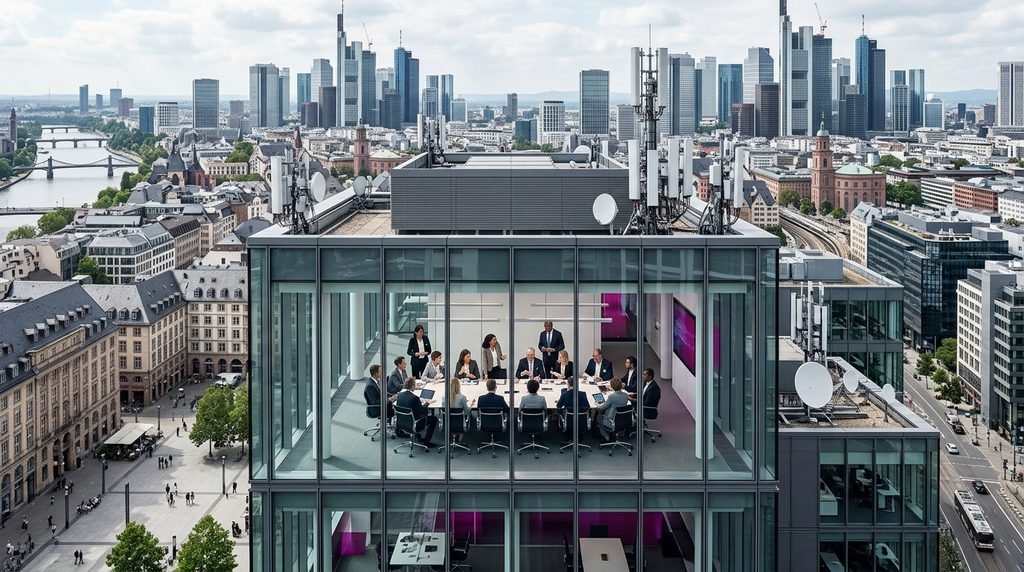
Not directly in the simple sense that the question may suggest. Deutsche Telekom is a German company in which the German state and the state-owned development bank KfW hold significant interests. That creates an indirect connection between the German public sector and T-Mobile US through Deutsche Telekom.
The ownership chain is important:
- T-Mobile US is a U.S. publicly traded company.
- Deutsche Telekom is its controlling shareholder.
- The German state and KfW are significant shareholders in Deutsche Telekom.
This does not mean that the German government directly holds every T-Mobile share or personally manages T-Mobile’s everyday operations. Corporate ownership, voting rights, government shareholdings in the parent company, and executive management are distinct matters.
The most accurate short description is that T-Mobile US is a U.S. company controlled by a German telecommunications group.
How Did Deutsche Telekom Become T-Mobile’s Owner?
T-Mobile US developed from earlier U.S. wireless businesses before becoming part of Deutsche Telekom.
The VoiceStream years
The business traces its roots to VoiceStream Wireless, which grew out of the U.S. wireless industry in the 1990s. VoiceStream used GSM technology and expanded through business development and acquisitions.
Deutsche Telekom’s acquisition in 2001
Deutsche Telekom acquired VoiceStream in 2001, establishing the foundation for its U.S. wireless business. The company subsequently adopted the T-Mobile USA name as Deutsche Telekom expanded the T-Mobile brand internationally.
The acquisition explains why a carrier that operates in the United States has a German parent company. The company’s American operations and its parent’s German headquarters are not contradictory; they describe different parts of the corporate structure.
The public-company era
T-Mobile US became a publicly traded company in 2013 following a business combination with MetroPCS. That transaction changed the ownership structure and established the basis for public-market trading under the T-Mobile US corporate identity.
Deutsche Telekom remained a significant shareholder and continued increasing its position over time. Its voting-control position was later strengthened by arrangements involving shares held by SoftBank.
The Sprint merger in 2020
T-Mobile completed its merger with Sprint in 2020. The transaction reshaped the U.S. wireless market and affected the companies’ shareholder arrangements. SoftBank’s connection to the combined business stems in part from its prior ownership of Sprint and the terms associated with the transaction.
The Sprint merger is one reason older articles may list different shareholder percentages from newer ones. Ownership has evolved through transactions, share purchases, and repurchases rather than remaining fixed.
Does AT&T Own T-Mobile?
No. AT&T does not own T-Mobile US.
In 2011, AT&T announced a proposed acquisition of T-Mobile USA for approximately $39 billion. The transaction did not close, so it did not make AT&T the owner of T-Mobile.
The historical proposal still appears in older news coverage and can cause confusion when readers search for T-Mobile’s ownership. It is important to distinguish a proposed acquisition from a completed one. The current parent-company relationship is with Deutsche Telekom, not AT&T.
Is Deutsche Telekom Planning to Merge With T-Mobile US?
Reports in April 2026 described early discussions about a possible fuller combination of Deutsche Telekom and T-Mobile US. The idea was reported as a potential corporate transaction, not as a completed change in ownership.
A proposed merger can involve several stages: exploratory discussions, a formal agreement, board and shareholder approvals, regulatory review, and completion. A report that companies are considering a transaction does not establish that all these steps have occurred.
For readers checking the issue, the important questions are whether the companies have announced a definitive agreement, whether the necessary approvals have been obtained, and whether the transaction has actually closed.
Until a transaction is completed, Deutsche Telekom’s existing controlling position remains the relevant ownership fact. Any article discussing the merger possibility should be updated when official company announcements or regulatory filings materially change the status.
Who Runs T-Mobile US Day to Day?
Ownership and management are related, but they are not the same. Deutsche Telekom is the controlling shareholder, while T-Mobile US has its own board of directors and executive leadership responsible for running the U.S. business.
The board oversees corporate governance and major strategic decisions. Executives manage operations, products, customer services, network investments, staffing, and other day-to-day business activities.
Leadership titles can change, so readers looking for the current chief executive or board chair should check the latest company leadership and governance disclosures. An ownership article should avoid presenting an outdated executive title as current simply because the person held the role when an earlier article was published.
What Does T-Mobile’s Ownership Mean for Customers?
For most customers, the ownership structure does not change the basic way they choose or use a mobile service. T-Mobile US operates the U.S. service, provides its plans, maintains its network, and handles its customer relationships through its U.S. business.
Ownership matters more when considering corporate strategy, acquisitions, investment decisions, governance, and the company’s relationship with its parent group. A controlling shareholder can have significant influence over major strategic matters, while the U.S. company remains responsible for its own operations and applicable legal obligations.
Customers should not assume that a foreign parent company automatically means their service is managed from another country, nor should they assume that public trading means the company has no controlling shareholder.
Frequently Asked Questions
Who owns T-Mobile right now?
Deutsche Telekom AG is the controlling shareholder of T-Mobile US. The company also has public-market investors who own the remaining shares.
Is T-Mobile owned by Germany?
T-Mobile US is controlled by Deutsche Telekom, a German telecommunications company. The German state and KfW have significant interests in Deutsche Telekom, but that is different from the German government directly owning all of T-Mobile US.
What percentage of T-Mobile does Deutsche Telekom own?
The answer depends on the measurement. Deutsche Telekom reported a 45.5% direct capital stake as of June 30, 2026, a 54.2% ownership stake after accounting for T-Mobile US treasury shares, and 55.1% voting rights under the relevant arrangements. These figures should always be accompanied by their date and definition.
Is T-Mobile stock publicly available?
Yes. T-Mobile US shares trade on Nasdaq under the ticker TMUS. Investors should consult current market information and company filings for up-to-date stock and shareholder data.
Does SoftBank still own T-Mobile?
SoftBank has been part of T-Mobile’s shareholder history, especially following the Sprint merger. Its current shareholding should be verified using recent disclosures because its position has changed over time.
Did AT&T ever buy T-Mobile?
No. AT&T proposed buying T-Mobile USA in 2011, but the deal did not close. T-Mobile US is currently controlled by Deutsche Telekom.
Has T-Mobile merged with Deutsche Telekom?
The companies have been the subject of reports about a possible fuller combination, but reports of discussions should not be confused with a completed merger. Check current official announcements and regulatory disclosures for the latest status.
Conclusion
T-Mobile US is a publicly traded American telecommunications company controlled by Deutsche Telekom, a German telecommunications group. The relationship began with Deutsche Telekom’s acquisition of VoiceStream in 2001 and continued through later corporate transactions, including the Sprint merger.
Ownership percentages can be confusing because direct capital holdings, treasury-share-adjusted ownership, and voting control are different measures. The latest available disclosures should be used with their dates and definitions clearly stated.
For anyone asking who owns T-Mobile, the essential answer is simple: Deutsche Telekom is the controlling shareholder, while other investors own shares in the publicly traded T-Mobile US business.


[…] by Verizon, AT&T, and T-Mobile through one provider. However, your experience still depends on local coverage, your phone, your plan, and the kind of customer support you […]