

A fluid bed dryer is an industrial drying system that removes moisture from wet solids by passing a controlled stream of gas, usually heated air, through a bed of particles. The airflow suspends and mixes the particles, exposing a large portion of their surfaces to the drying medium. This promotes heat transfer, moisture evaporation, and consistent drying when the material and operating conditions are suitable.
Fluid bed dryers are used in pharmaceutical manufacturing, food processing, chemicals, fertilizers, minerals, and other industries that handle powders, granules, crystals, or pellets. Depending on the process, a unit may operate in batches or as part of a continuous production line.
Choosing the right system requires more than comparing machine size or heating capacity. Particle characteristics, initial moisture, target moisture, throughput, product sensitivity, cleaning requirements, energy use, and safety all influence the final design.
What Is a Fluid Bed Dryer?
A fluid bed dryer is a piece of process equipment designed to dry solid particles by bringing them into close contact with a moving gas stream. The material rests on an air-distribution surface, commonly a perforated plate. Air supplied from below passes through the openings and moves upward through the solids.
When the airflow reaches a suitable velocity, the particles become suspended and move in a way that resembles a boiling liquid. This condition is called fluidization.
The resulting movement improves contact between the drying gas and the particles. Heat transfers from the gas to the wet material, allowing moisture to evaporate and leave with the exhaust stream. Proper control of airflow, temperature, and residence time helps achieve the required final moisture level.
Fluid bed dryers can be designed for relatively small production batches or large industrial throughputs. Some are intended primarily for drying, while specialized fluid bed processors can also perform operations such as granulation, agglomeration, or coating.
Working Principle of a Fluid Bed Dryer
The working principle is based on controlled fluidization and the transfer of heat and moisture between the drying gas and solid particles.
1. Air intake and conditioning
Ambient or recirculated air enters the system through an air-handling arrangement. Depending on the process, the air may pass through filters, a heater or heat exchanger, and control dampers before reaching the drying chamber.
The air must be suitable for the product and process. Temperature, humidity, cleanliness, and flow rate can all influence drying performance.
2. Air distribution through the material
The conditioned air enters a plenum beneath the product-supporting distributor plate. The plate spreads the air across the bed so that it passes through the material rather than concentrating in only a few areas.
Uniform distribution is important. Poor distribution can create dead zones, uneven fluidization, or inconsistent final moisture.
3. Fluidization of particles
As air moves upward through the bed, drag forces act on the particles. When the flow reaches the required operating range, the particles become suspended and move freely enough to mix with one another.
The necessary velocity depends on particle size, density, shape, moisture, and other physical properties. A single airflow setting is therefore not appropriate for every product.
4. Heat transfer and moisture evaporation
The drying gas transfers heat to the wet particles. Moisture at the surface evaporates first, while moisture inside a particle may need additional time to move toward the surface before it can evaporate.
The moist exhaust gas then carries the evaporated water away from the bed. The drying rate depends on the material’s moisture characteristics, the temperature and humidity of the gas, airflow, and the time the product remains in the dryer.
5. Exhaust treatment and product recovery
Exhaust air may carry small particles out of the drying chamber. Filters, baghouses, cyclones, or other collection arrangements may be needed to control dust and recover valuable fines.
The correct arrangement depends on particle size, product value, emissions requirements, and the nature of the material. Collected fines should be handled according to the process specification rather than automatically returned to the product.
6. Discharge and optional cooling
When the material reaches its required moisture content, it is discharged from the equipment. In a continuous system, product movement and residence time are controlled by the equipment design and operating settings.
Some systems include a cooling zone so that the product can be brought to a suitable temperature before storage, packaging, or the next manufacturing step.
Main Components of a Fluid Bed Drying System
The exact equipment configuration varies, but a typical system may contain the following components.
- Drying chamber: Holds the material while the drying process takes place.
- Air-distribution plate: Spreads the incoming gas across the bed.
- Air plenum: Directs conditioned air toward the distributor.
- Blower or fan: Supplies the airflow needed to operate the bed.
- Heating system: Raises the gas temperature to the required process setting.
- Filters and dust collection: Remove unwanted particles from incoming or exhaust air, as required.
- Feed and discharge equipment: Transfer material into and out of the dryer.
- Sensors and controls: Monitor and regulate parameters such as temperature, airflow, pressure, and process time.
- Exhaust and heat-recovery equipment: Manage moist air and, where practical, recover usable energy.
A well-designed installation considers these components as one integrated system. A capable drying chamber cannot compensate for inadequate air distribution, unsuitable dust collection, or poorly controlled feed conditions.
Types of Fluid Bed Dryers
Different fluid bed designs are suited to different material properties, production requirements, and process objectives.
Static fluid bed dryer
A static fluid bed dryer has a stationary drying chamber and distributor. Air movement creates the fluidized state, while the product may move through the unit as a result of the bed’s flow characteristics or remain in place during a batch cycle.
This design can work well when the material has reasonably consistent particle properties and fluidizes predictably. It may be less suitable for materials that tend to stick together, segregate, or resist uniform suspension.
Vibrating fluid bed dryer
A vibrating fluid bed dryer combines airflow with mechanical vibration. Vibration helps move material through the machine and can improve handling when particles are coarse, irregular, fragile, or difficult to fluidize using air alone.
Continuous vibrating systems are often considered for bulk solids that need controlled transport and residence time. Their suitability depends on how the material responds to vibration and airflow under actual operating conditions.
Agitated fluid bed dryer
An agitated design uses mechanical movement within the bed to assist mixing and heat transfer. This can help with certain cohesive or challenging materials that do not fluidize evenly under conventional airflow.
Agitation adds mechanical complexity, so the design must be selected according to the material’s behavior and the process objectives.
Batch fluid bed dryer
In batch processing, a defined quantity of material is loaded, dried under controlled conditions, and discharged before the next batch begins.
Batch systems are common when production involves multiple formulations, different product lots, or processes requiring controlled and documented cycles. The loading arrangement, cleaning process, and turnaround time between batches can influence overall productivity.
Continuous fluid bed dryer
A continuous dryer receives wet material at one end and discharges dried material at another. Product movement, airflow, temperature, and residence time are managed to achieve the required drying result.
Continuous systems can suit high-throughput manufacturing, particularly when feed characteristics and production conditions remain reasonably consistent.
The best configuration is not determined by the equipment name alone. Representative material testing and process evaluation are often needed to confirm that a design can meet the required product specification.
Applications of Fluid Bed Dryers
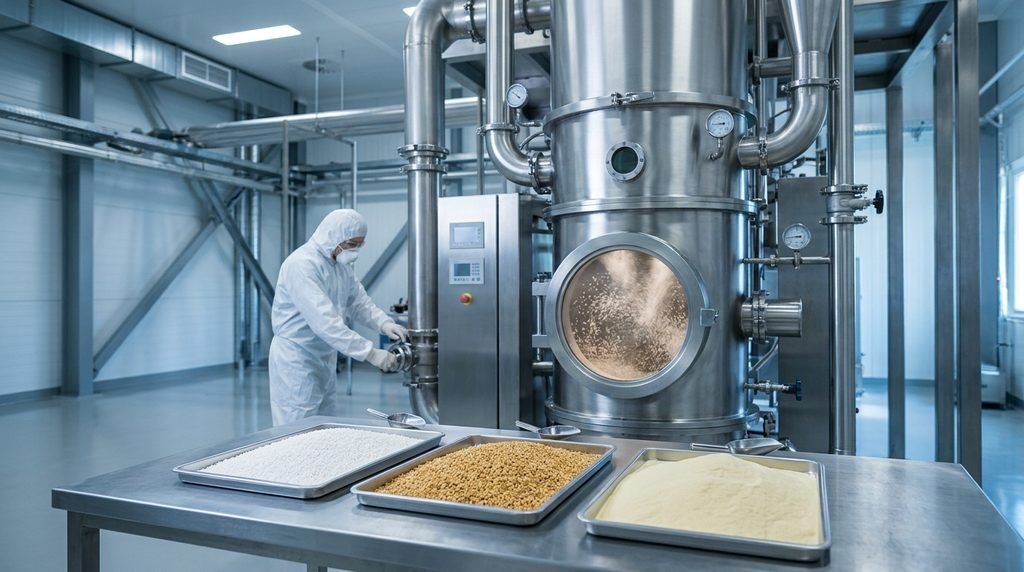
Fluid bed dryers are used wherever solid materials need controlled moisture removal and can be processed effectively in a fluidized state.
Pharmaceutical manufacturing
Pharmaceutical facilities use fluid bed equipment to dry granules produced during wet granulation and to process suitable powders and particles. Some fluid bed processors can also support granulation or coating, depending on their configuration.
Pharmaceutical applications place particular importance on product uniformity, cleanability, batch records, material compatibility, and control of cross-contamination. Equipment selection should account for the relevant quality system and regulatory requirements.
Food and dairy processing
Food manufacturers may use fluid bed dryers to process ingredients, grains, cereals, granules, and other suitable solids. Drying conditions must protect the product’s required texture, color, flavor, and functional properties.
Sanitary construction, access for inspection, effective cleaning, and control of airborne particles are important where food safety and allergen management apply.
Chemical manufacturing
Chemical producers use fluid bed dryers for suitable powders, crystals, granules, and pellets. The process may require carefully controlled temperature, airflow, containment, and exhaust treatment.
Where solvents or combustible materials are involved, the system may need specialized design features and a formal process-safety assessment.
Fertilizers and minerals
Fluid bed systems can dry suitable fertilizer particles, mineral products, and other bulk solids. Continuous configurations may be attractive when production requires substantial throughput.
However, abrasion, particle-size variation, high feed moisture, and dust generation should be assessed before selecting a system.
Biomass and other industrial materials
Certain biomass materials, recycled products, and industrial by-products may be processed in fluid bed dryers. Feed preparation can be essential because irregular shape, inconsistent moisture, and variable particle sizes can make stable fluidization difficult.
Not every wet solid is suitable for this technology. Materials that are extremely sticky, highly cohesive, or too large for effective fluidization may require pretreatment or an alternative drying method.
Advantages of Fluid Bed Dryers
Efficient heat and mass transfer
The movement of particles exposes substantial surface area to the drying gas. This supports effective heat transfer and moisture removal when the bed is properly fluidized.
Potentially uniform drying
Continuous mixing can reduce differences between particles, although uniformity still depends on airflow distribution, material consistency, temperature control, and residence time.
Flexible process configurations
Fluid bed equipment is available in batch and continuous arrangements, with static, vibrating, or agitated designs. This allows the process to be tailored to the product and production line.
Combined drying and cooling
Some systems incorporate separate drying and cooling zones. This can reduce the need for separate handling equipment between operations, depending on the process layout.
Integration with other operations
Specialized fluid bed processors may combine drying with granulation, agglomeration, or coating. Combining steps can simplify material handling when the product and process are suitable.
Opportunities for energy recovery
Heat exchangers or exhaust-air recirculation may recover part of the energy that would otherwise leave the system. The actual benefit depends on the gas composition, moisture load, product requirements, and overall installation.
Disadvantages and Limitations
A fluid bed dryer is not the best choice for every product or plant.
Material must fluidize adequately. Sticky or cohesive solids can clump, while irregular particles may behave unpredictably. Pretreatment or a different design may be necessary.
Fine particles can escape with the exhaust. Dust collection and product recovery may be essential, particularly when the material is valuable or creates an emissions concern.
Air handling can consume significant energy. Heating large quantities of air and moving it through the system require energy. Efficiency depends on the operating conditions and system design.
Product attrition or segregation may occur. Particle movement can cause breakage, and materials with widely differing particle properties may separate rather than mix uniformly.
Process control requires careful setup. Temperature, airflow, moisture, and residence time interact. Incorrect settings may lead to wet material, excessive drying, product damage, or unstable operation.
Safety requirements may be demanding. Combustible dust, electrostatic charging, hot surfaces, and flammable vapors can create serious hazards. Appropriate safeguards must be selected for the actual material and process.
These limitations should be assessed before purchase, not discovered after equipment installation.
Factors That Affect Fluid Bed Drying Performance
Several variables determine whether a fluid bed dryer reaches its moisture and production targets.
Particle size, shape, and density
These properties affect how particles move in the airflow. Small particles may dry quickly but can be carried into the exhaust, while larger or denser particles may require different fluidization conditions.
Initial moisture content
Material entering with more moisture may need additional drying time or a different process arrangement. The type of moisture also matters: surface moisture behaves differently from moisture held within a particle.
Drying-air temperature and humidity
Higher temperatures can increase the driving force for evaporation, but the product’s heat sensitivity sets practical limits. Humidity in the incoming gas also affects its ability to accept additional moisture.
Airflow and pressure conditions
Insufficient airflow may result in poor fluidization. Excessive airflow can increase energy use and carry fines out of the bed. The target operating range must be established for the specific material and machine.
Residence time and feed consistency
The material needs enough time in the dryer to reach the target moisture content. Fluctuations in feed rate, particle properties, or moisture can lead to inconsistent results, particularly in continuous systems.
Exhaust handling and heat recovery
The exhaust arrangement influences moisture removal, dust emissions, product recovery, and energy use. It should be designed around the process requirements rather than added as an afterthought.
Fluid Bed Dryer vs. Rotary Dryer vs. Tray Dryer
The right comparison depends on the material, production rate, final moisture target, and available utilities.
| Factor | Fluid bed dryer | Rotary dryer | Tray dryer |
|---|---|---|---|
| Drying method | Gas passes through a fluidized bed of particles | Material moves through a rotating drum while contacting the drying medium | Material is spread on trays and dried in an enclosure |
| Common use case | Suitable powders, granules, crystals, and pellets | Many bulk solids, including some coarse or variable feed materials | Batch drying where material can be arranged in trays |
| Mixing and exposure | High particle movement when fluidization is stable | Tumbling and lifting action | Usually limited movement unless trays or material are manipulated |
| Feed requirements | Fluidization behavior is critical | Often accommodates a wider range of bulk feed properties, depending on design | Material must be suitable for tray loading and heat exposure |
| Key consideration | Airflow, fines, and particle behavior | Drum design, material movement, and residence time | Batch time, loading, unloading, and temperature uniformity |
No single technology is universally superior. A rotary dryer may be a better fit for some coarse or variable bulk materials, while a tray dryer may suit particular small-batch operations. A fluid bed dryer is worth evaluating when the material can be fluidized reliably and the process benefits from close gas-to-particle contact.
How to Select the Right Fluid Bed Dryer
Before requesting quotations, prepare a clear description of the material and the intended process.
- Define the material. Document particle size distribution, shape, density, stickiness, heat sensitivity, and relevant safety characteristics.
- Measure the moisture requirement. Establish the incoming moisture range and the required final moisture content using a defined measurement method.
- Specify production capacity. State the expected feed rate, operating hours, batch size or continuous throughput, and any seasonal or product-related variation.
- Confirm product quality requirements. Identify acceptable limits for breakage, particle-size changes, color, texture, or other critical properties.
- Choose the operating arrangement. Determine whether batch or continuous processing is appropriate and whether a static, vibrating, or agitated design is required.
- Review the complete system. Include air heating, fans, filtration, exhaust treatment, controls, cooling, utilities, and product handling.
- Evaluate cleaning and maintenance. Consider access, changeover time, spare parts, filter replacement, inspection, and service availability.
- Request process testing where needed. Representative trials can help establish drying behavior, airflow requirements, residence time, and achievable product quality before committing to a full-scale system.
For used equipment, additionally verify the actual machine condition, previous service history, available documentation, control-system compatibility, refurbishment needs, and availability of critical parts. A low purchase price does not necessarily mean a low total cost of ownership.
Safety, Cleaning, and Maintenance
Safety planning should reflect the product and process. Combustible dust may require an appropriate dust-hazard assessment and suitable protection measures. Flammable solvents or vapors may call for specialized containment, ventilation, gas monitoring, or inert operation. Static control, grounding, temperature limits, and safe access for maintenance should also be evaluated as applicable.
In pharmaceutical and food applications, cleaning procedures must be designed to control contamination and support the relevant quality requirements. Materials of construction, surface finish, seals, access points, and the ability to inspect the interior can all influence cleanability.
Routine maintenance commonly includes inspecting filters, fans, seals, bearings, drives, sensors, heating equipment, and air-distribution components. The manufacturer’s maintenance schedule and the actual process conditions should determine service intervals.
Changes in pressure drop, airflow, drying consistency, or product loss may indicate that the system needs inspection. Operators should follow approved procedures rather than changing process settings without understanding the cause of the problem.
Frequently Asked Questions
What is the main purpose of a fluid bed dryer?
Its main purpose is to remove moisture from suitable solid particles by suspending and mixing them in a controlled stream of drying gas. The process is used when effective gas-to-particle contact can deliver the required moisture level and product quality.
What is the principle of a fluidized bed dryer?
The principle is fluidization. Gas flows upward through a bed of solids at a velocity sufficient to suspend and mobilize the particles. Heat transfers from the gas to the material, moisture evaporates, and the exhaust carries the vapor away.
Which materials can be dried in a fluid bed dryer?
Suitable materials can include granules, powders, crystals, pellets, food ingredients, chemical products, fertilizers, and minerals. Suitability depends on particle characteristics, moisture, heat sensitivity, and whether the material can be fluidized reliably.
What is the difference between a fluid bed dryer and a fluid bed processor?
A fluid bed dryer is primarily designed to remove moisture. A fluid bed processor may be configured to perform additional operations such as granulation, agglomeration, or coating. The capabilities depend on the specific equipment and process design.
Is a fluid bed dryer energy-efficient?
It can provide effective heat transfer and may allow heat recovery, but total energy use depends on airflow, heating requirements, exhaust losses, product moisture, and system design. Efficiency should be assessed using process-specific data rather than a universal percentage.
How long does fluid bed drying take?
There is no single drying time that applies to all materials. The required time depends on initial and final moisture content, particle size, material properties, airflow, temperature, equipment design, and the production target. Trials or validated process data are needed for a reliable estimate.
Conclusion
A fluid bed dryer uses controlled airflow to suspend and mix solid particles, improving contact between the material and the drying gas. This makes it a useful option for suitable pharmaceutical, food, chemical, mineral, and bulk-solids applications.
Its performance depends on more than heat alone. Material properties, airflow distribution, temperature, residence time, dust collection, and safety requirements all influence the result. Static, vibrating, agitated, batch, and continuous configurations address different processing needs, so the choice should follow the material and production requirements.
The most reliable way to select a fluid bed dryer is to define the moisture target, throughput, product-quality limits, utilities, and safety needs first. Where the material is challenging or the process is high-value, representative testing and a complete system evaluation can help reduce the risk of choosing unsuitable equipment.



[…] as an incorrect cycle setting, a blocked lint screen, or an overloaded drum. Others may involve electrical components, the drive system, or the heating […]